

Please connect from a desktop to activate our interactive interface

Understanding Basic Authentication
A straightforward authentication scheme where the client provides a username and password via a Base64-encoded string in the HTTP Authorization header, strictly requiring TLS encryption to ensure credentials remain protected during transmission.
Basic authentication is a widely used method for securing APIs, websites, and other online services. It involves sending a username and password with each request to authenticate the user or client. This article aims to provide a concise overview of basic authentication, its importance, and how to test APIs that utilize this authentication method.
What is Basic Authentication?
Basic Authentication is a method for an HTTP user agent (e.g., a web browser) to provide a username and password when making a request. When employing Basic Authentication, users include an encoded string in the Authorization header of each request they make. The string is used by the request's recipient to verify users' identity and rights to access a resource.

Basic Authentication Header
The authorization header is what carries the information related to user identity for the validation of their rights. This part is later carried forward to the server. Once the server processes the user details, access is granted to the end-user. You can check the Open API Specification for detailed Security Schema to see which authentication header is acceptable by API Producers.
Authentication header Types
Basic Auth
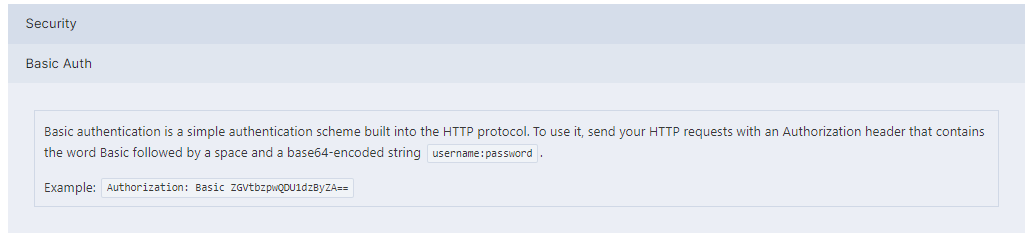
It is the simplest type of auth header built over HTTP protocol. The header features the word Basic and a base 64-encoded string username.
Authorization: Basic <credentials>
Bearer Token
It involves the processing of bearer tokens that are server-generated cryptic strings. This token-based method may use various encryption algorithms, such as: RS512, RS384, ES256, etc.
Authorization: Bearer <token>
Why is Basic Authentication Important?
Basic authentication is important because it provides a basic level of security by requiring credentials for access. It is widely supported by various platforms and frameworks, making it easy to implement. This authentication transfers the tokens over HTTP. Such token processing increases the possibility of third-party manipulation. Also, there is no encryption at work. For a more secure method, we recommend using OAuth, where the token processing happens on SSL protocol that is safe and features better encryption.
Testing APIs that Use Basic Authentication:
To test APIs that use basic authentication, you can follow these steps:
1. Obtain the API documentation: The documentation should provide details on the required headers, including the "Authorization" header format.
2. Choose a testing tool: There are several tools available for testing APIs, such as Insomnia, Postman, cURL, or even programming languages like Python or JavaScript.
3. Set up the Authorization header: In your chosen testing tool, add the "Authorization" header to your request. The value should be "Basic" followed by a base64-encoded string of the username and password.
4. Send the request: Once the headers are set up, send the request to the API endpoint. If the credentials are valid, you should receive a successful response.
In case of any queries, please write your query to us: Contact us.